



If you have been reading since the beginning you know that my second target for AP, and really more of an afterthought at the time, was the Orion Nebula M42. I was not at all pleased with the image, too many problems to really even get started. Now, a few months later, I had some ideas on how to correct some of those issues.
 Here is my original image of the Orion Nebula for comparison:
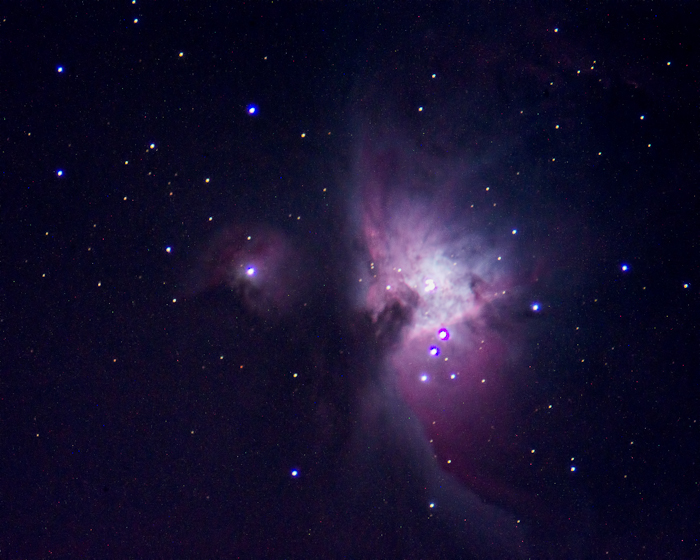
A little better image of M42 don’t you think? I started off with of course better focus, then added better tracking, and lastly applied a little of my daytime photography knowledge and tricks to it making an HDR image to deal with the really bright core vs very dim outer dust lanes.
In this one image are stacks of 5 second, 10 second, 15 seconds, 30 seconds, 45 seconds, 60 seconds, 120 seconds and finally 180 seconds images. Each stack is then combined using HDR Efex pro to create the composite and then stretched in Photoshop. That’s 90 lights, 20 darks and 20 bias all combined into this one image. Funny thing is Messier 42 is one of the brightest objects in the sky and can clearly be seen with the naked eye as a fuzzy patch in the sky at below Orion’s belt. Yet even for being this bright it is the hardest object I have shot to date with all this combining and processing.
If you want a little more comparison, check out the Messier 42 image shot by the Hubble Space Telescope. Obviously mine don’t even hold a candle to what the Hubble can do but it is very interesting to see the same details in both images and realize I gathered much of the same data with amateur gear. That is simply amazing. It also really makes me strive to see what else I can accomplish.
Thanks for looking at my Orion Nebula images!
Share this post!


Hi
I’m new in the business. Ijust shot m42 using: samsung S21 ultra with 25mm Eyepiece on celestron 4se (4″, 1325 mm focus), alt-az tracking (technical reasons), no filter, in 8-9 Bortle area. I’ve shot 210 lights, 30 darks and 30 biases with 4sec and 3200 ISO.
Next I stacked in Siril and streched in Graxpert. Only 13 out of 210 lights were stacked due to poor conditions. I write you because my m42 image is very like your original image- same “seahorse” and ngc 1977 on the left.
You wrote about second image:
“In this one image are stacks of 5 second, 10 second, 15 seconds, 30 seconds, 45 seconds, 60 seconds, 120 seconds and finally 180 seconds images. Each stack is then combined using HDR Efex pro to create the composite and then stretched in Photoshop. That’s 90 lights, 20 darks and 20 bias”. So there are 8 sets of lights, but only 20 darks and biases.
As far as I understand each set has to be with its own sets of calibration frames. And why you didn’t shot flats?
Please advise
Thank you in advance
Dimitri